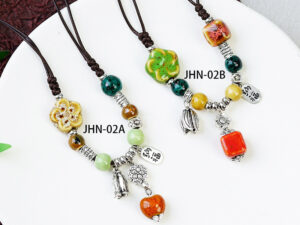

According to relevant records, in 1966, early Neolithic tombs were discovered in Donghulin Village, Mentougou, Beijing. A necklace made of small snail shells was found on the neck of a young girl’s remains. It indicates that humans have been wearing necklaces and other accessories for a long time.Practicality is greater than decoration.But at that time, it was difficult to say whether wearing a necklace was for aesthetic purposes. Because in the history of decorative arts, utilitarianism has come before and surpassed artistry, which has been confirmed by many materials.
Protect oneself and life
Wearing decorative items around the neck is a way for Africans to protect their lives. They believe that the connection between the neck, head, and torso is the key to life. Therefore, it must be adorned with ornaments to protect it with supernatural magic. Totem ethnic groups often choose a part of their totem as a talisman for their neck. Hanging animal teeth, horns, shells, turtle shells, etc. around the neck.
Australians also wrap themselves in kangaroo fur or wear kangaroo teeth in a zigzag pattern on their chests. Undoubtedly, it is all for the purpose of seeking blessings from the magic of totems. In the distant Paleolithic era, mountaintop cave people connected small stone beads, small stones, animal teeth, animal bones, and other perforations and hung them in front of them. Many people believe that this is the predecessor of necklaces.

Counting function
Ethnographers believe that the act of primitive ethnic groups wearing necklaces was not for beauty, but for the purpose of counting and recording events, at most just to compete among their peers who hunted more animals. It is for a utilitarian purpose. The gradual development from utilitarianism to aesthetics has been formed through the passage of time.
In the Neolithic Age, it was found from excavated tombs that these ornaments had many traces of artificial production in terms of particle size and material selection. In some large unearthed cultural relics, jade strings and ornaments were also found. These jade ornaments were all formed through certain craftsmanship. Some scholars believe that manufacturing decorative items is the earliest technological process for humans.
Status symbol
After entering the class society, although both the poor and the nobles wore necklaces, there were significant differences in the materials used. The aristocratic class mainly uses jade, while the common people decorate themselves with snails, shells, shells, and other materials. In ancient times, women not only wore necklaces, but also wore tassels. Yingluo, also known as Yingluo, was originally a decoration around the neck of a Buddha statue.